Ming Wanli 1591 Blue & White Compass
Singapore Capt. Lim Keow Wah
In 2009, the author acquired at a Singapore auction a three-part integrated porcelain compass that differs from ordinary porcelain compasses. The compass shown in Figure 1, bearing the mark “万历辛卯如城家藏” "Wanli Xinmao Rucheng jiacang" (made in the Xinmao year of the Wanli reign, from the Rucheng family collection), is a piece of Jingdezhen folk-kiln porcelain fired in the nineteenth year of the Wanli reign of the Ming dynasty (1591). This mark combines a precise sexagenary-cycle date with a private studio name, making it an important piece of physical evidence for the study of high-quality custom-made porcelain navigational compasses from late Ming Jingdezhen. Before turning to the main subject, I will first introduce other porcelains bearing marks of the same type.
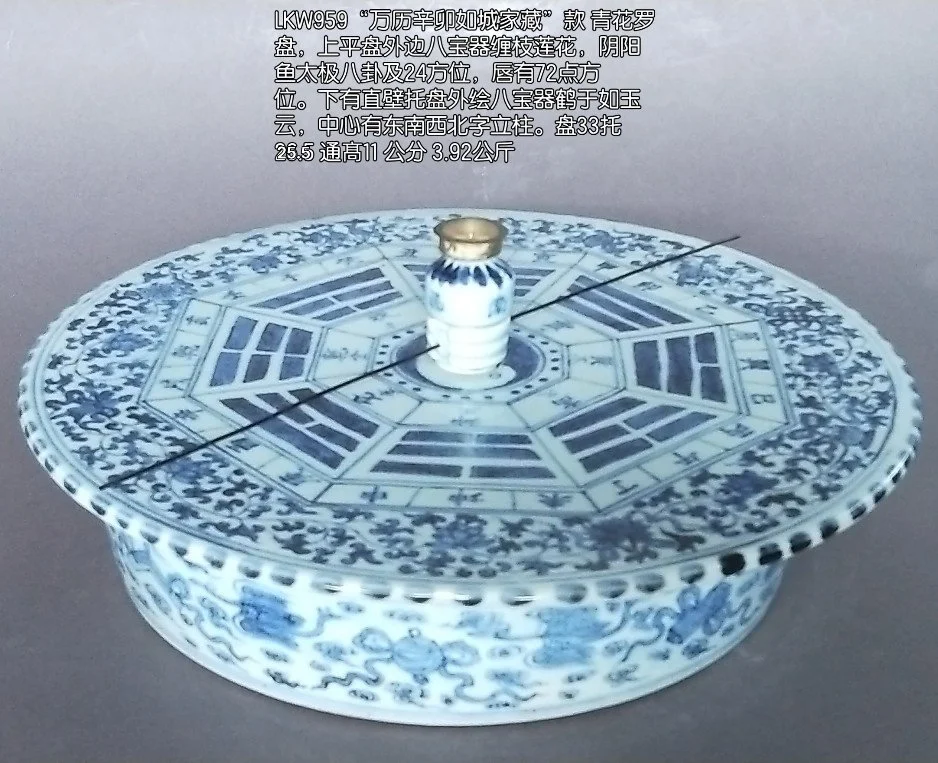
Figure 1. Blue-and-white compass with the mark “万历辛卯如城家藏”"Wanli Xinmao Rucheng jiacang" — compass pillar, plate, and bowl, three parts in one; diameter 33 cm, height 11 cm, weight 3.92 kg. Collection of Lim Keow Wah
• The British Museum. It holds several pale-celadon-glazed bowls bearing this mark, one of which was formerly in the collection of the renowned collector Sir Percival David (accession number PDF.A.523), and another formerly in the collection of George Eumorfopoulos.
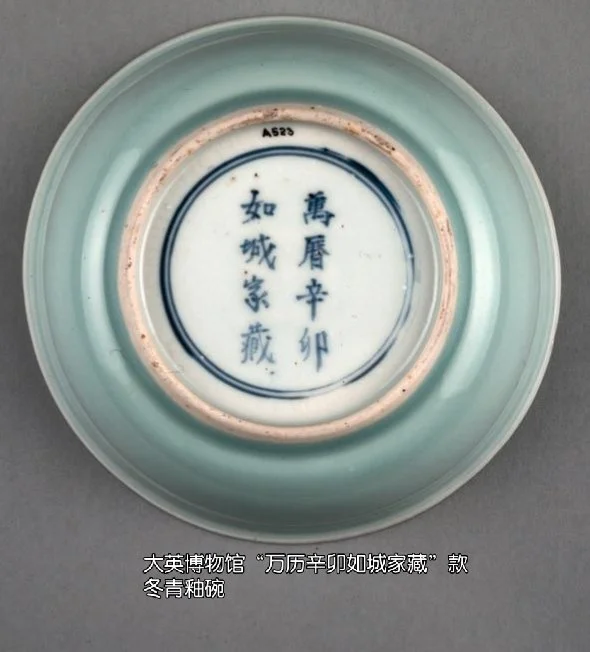
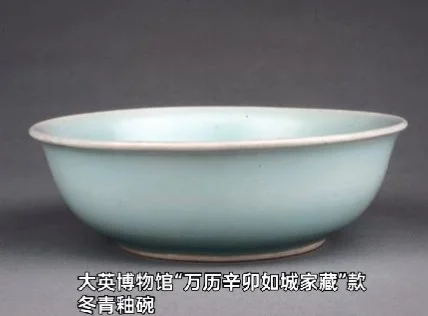
Figure 2. Celadon-glazed bowl with the mark “万历辛卯如城家藏” "Wanli Xinmao Rucheng jiacang" — diameter 16.3 cm, height 5.4 cm. Collection of the British Museum, accession number PDF.A.523.
• The Museum of Far Eastern Antiquities (Östasiatiska Museet), Stockholm. It holds a celadon-glazed bowl of the same mark, formerly in the collection of Axel and Nora Lundgren (accession number ÖM-1977-0098).
• Bristol Museum & Art Gallery, England. It holds a piece of the same mark, formerly in the collection of Ferdinand Schiller (accession number N2647).
• Hong Kong Museum of Art. Its collection also includes a celadon-glazed bowl bearing the mark "Wanli Xinmao Rucheng jiacang," recorded in Monochrome Ceramics of the Ming and Qing Dynasties.
The international auction market. At Christie's Hong Kong 2018 Spring Auctions, in the "Important Chinese Ceramics and Works of Art" sale of Christie's and other major international auction houses, a Ming "Wanli Xinmao Rucheng jiacang" celadon-glazed shallow bowl appeared with a sale record, and it was held in high regard by collectors of early and Ming-Qing monochrome wares.
The meaning and characteristics of the mark
• A precise date. “万历辛卯”"Wanli Xinmao" refers to the nineteenth year of the Wanli reign of the Ming Shenzong emperor (1591 CE), providing an absolute basis for dating the piece.
• A private studio name. “如城家藏”"Rucheng jiacang" (the Rucheng family collection) is the studio or family name of the patron who commissioned the piece. Most scholars identify it as a piece specially ordered from the Jingdezhen kilns by a literatus-collector of the "Ru" family, or by one who used "Rucheng" (the place name 如皋Rugao) as his sobriquet.
• The form of the inscription. The mark is usually written in underglaze blue, though one example is written in iron-red, on the exterior of the vessel; on this compass it appears on the small recessed base. It is typically an eight-character inscription in regular script arranged in two columns, enclosed within a single or double underglaze-blue ring, neatly and elegantly written.
This blue-and-white compass with the mark “万历辛卯如城家藏”"Wanli Xinmao Rucheng jiacang" brings together the porcelain-making craft of the late Ming, the culture of the navigational compass, and the tradition of private custom commissions, making it especially distinctive among the surviving pieces bearing the "Rucheng jiacang" mark.
Specifications of the blue-and-white compass with the mark "Wanli Xinmao Rucheng jiacang" the pillar, the compass plate, and the bowl:
• Outer diameter of the pillar above the plate surface: 3.0/3.3 cm
• Outer diameter of the pillar within the hole in the plate: 2.4 cm
• Height of the pillar projecting vertically above the plate surface: 4.3 cm
• Inner diameter of the hollow bore running straight through to the base: 0.7 cm
• Diameter of the horizontal hole running straight through pillar: 0.2 cm
• Diameter of the compass plate: 33 cm
• Inner diameter of the hole in the rose plate: 2.6 cm (smaller than the 3.0 cm outer diameter of the exposed pillar, so the plate is locked beneath the pillar and cannot be removed, though it can rotate)
• Thickness of the compass plate: 0.6 cm
• Clearance between the central hole of the plate and the pillar: 0.1 cm
• Diameter of the straight-walled circular supporting bowl: 25.5 cm
• Diameter of the small straight-walled circular supporting bowl inside the bowl: 8.5 cm (rim of the inner smaller bowl about 0.3cm higher than outer bowl, therefore rim of inner smaller bowl is the part that in contact and support the rotation of the plate.)
• Diameter of the recessed bi-disc 玉璧 base of the straight-walled circular bowl: 4.8 cm
• Depth of the recessed bi-disc base of the straight-walled circular supporting bowl: 0.5 cm
• Overall height of the piece: 11 cm
• Overall weight: 3.92 kg
Form and functional structure
Distinctive form: The whole piece is shaped like a large flat-rimmed round box, composed of three main parts:
Upper part — a circular hollow porcelain pillar rises from the inner base of the bowl, passing through the central hole of the circular porcelain compass plate above; the base of the pillar rests on the bottom of the bowl. The vertical central bore of the pillar, 7 mm in diameter, was designed to hold a dry compass with a round tenon, which is now lost. A horizontal hole 0.2 cm in diameter runs straight through the lower part of the pillar's central axis, for a copper wire used to fix the east–west orientation; the wire should have been 33 cm long, but it is now lost.
Middle part — a large flat circular porcelain plate (the compass rose plate) with a hollow central hole; the clearance around it is 0.1 cm, loose enough for the plate to rotate freely 360° around the pillar.
Lower part — a straight-walled circular porcelain bowl, with a flat, broad 玉璧bi-disc base below, designed so that it could sit on a round wooden stand and rotate. This kind of porcelain compass made specifically for navigation (also called a "porcelain compass" or ci luojing) is extremely rare among surviving Ming pieces, and it demanded very high standards of flatness in the fired body and accuracy in the circumference of the walls, to prevent kiln deformation from affecting the precision of the graduations. Inside there is a small cylindrical cup (glazed on the wall with transparent glaze) with a concentric vertical wall joined to the inner base, 8.5 cm in diameter.
Later-added components: 1. the metal orientation wire on the central axis of the plate face (the ”天心十道” "Tianxin shidao," the cross-lines through the center of heaven); 2. the copper case dry magnetic compass at the top of the central pillar; and 3. the jichimu (chicken-wing wood) stand with a raised rim and a round recess of 25.7 cm inner diameter — these are later replacement parts. This also indirectly confirms that the piece was actually used in the course of its transmission, or was restored according to the traditional form of a compass.
Layout of the blue-and-white decoration on the pillar, the compass rose, and the supporting bowl
• The pillar for holding the compass needle: the exposed lower half has three recessed bands painted with string (concentric) lines; on the upper half, the four characters “东南西北”"dong nan xi bei" (east, south, west, north) are written in the four directions; on the inward-sloping top are painted 15 small petals or elongated dots.
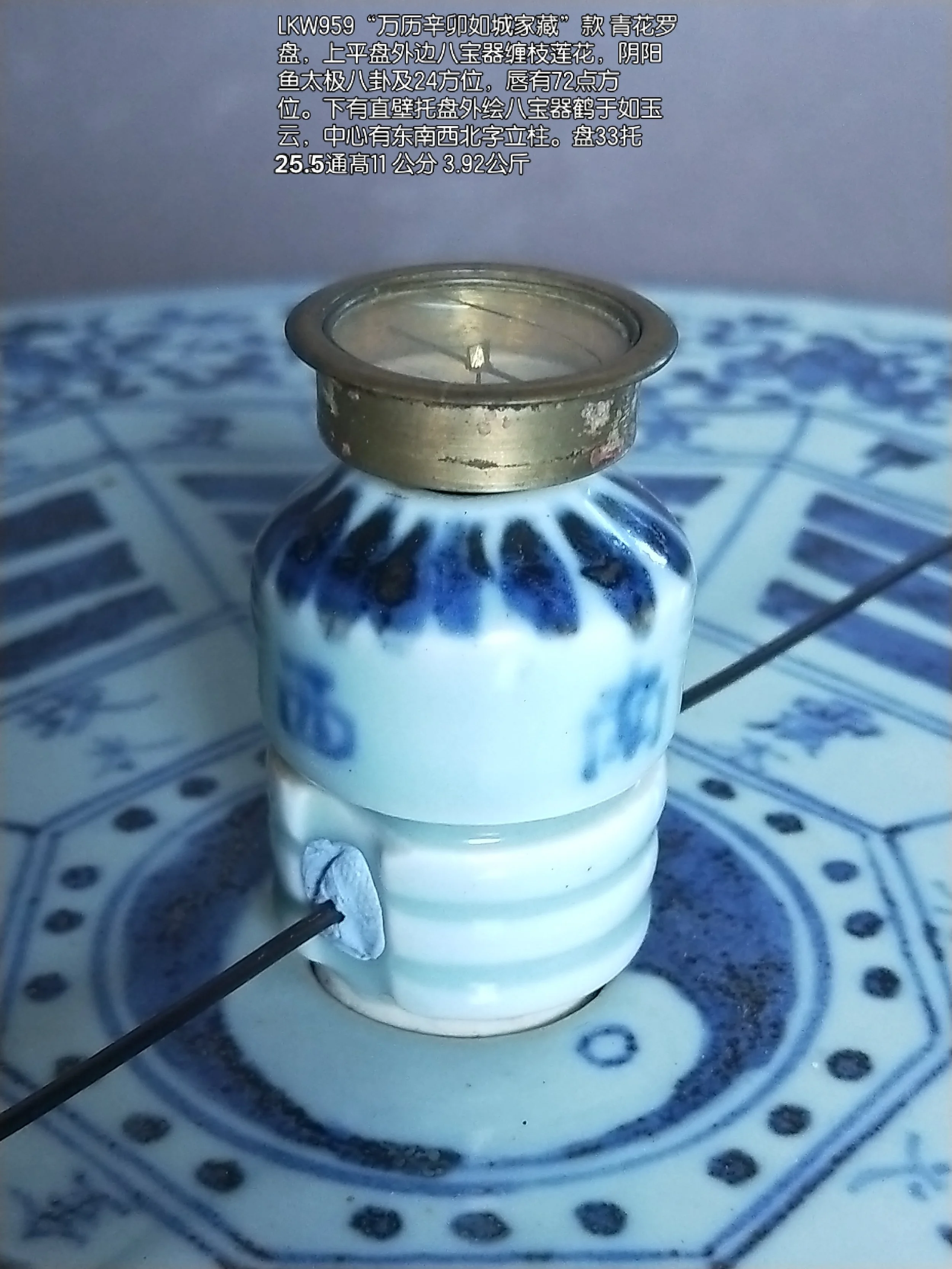
Figure 3. "Wanli Xinmao Rucheng jiacang," compass pillar with a later-added Republican-period copper dry compass and copper orientation wire. Collection of Lim Keow Wah
• The geomantic 堪舆(kanyu) system on the compass rose face: The face unfolds layer by layer from the center outward. Around the hollow center are painted a taiji diagram (the yin-yang fish) and inscriptions of the heavenly stems (or the five-phase directional positions). The middle layer carries the standard Former Heaven / Later Heaven bagua (Eight Trigrams) symbols (though the positions of some trigrams are painted incorrectly). The outer layer has the twenty-four directions (dots) evenly distributed around the circumference — )壬、子、癸、丑、艮、寅、甲、卯、乙、辰、巽、巳、丙、午、丁、未、坤、申、庚、酉、辛、戌、乾、亥)ren, zi, chou, chou, gen, yin, jia, mao, yi, chen, xun, si, bing, wu, ding, wei, kun, shen, geng, you, xin, xu, qian, hai — written neatly and clearly. Along an inner circular band is painted a ring of the Eight Treasures amid lotus flowers and leaf scrollwork. The outer lip is painted with 72 direction points.
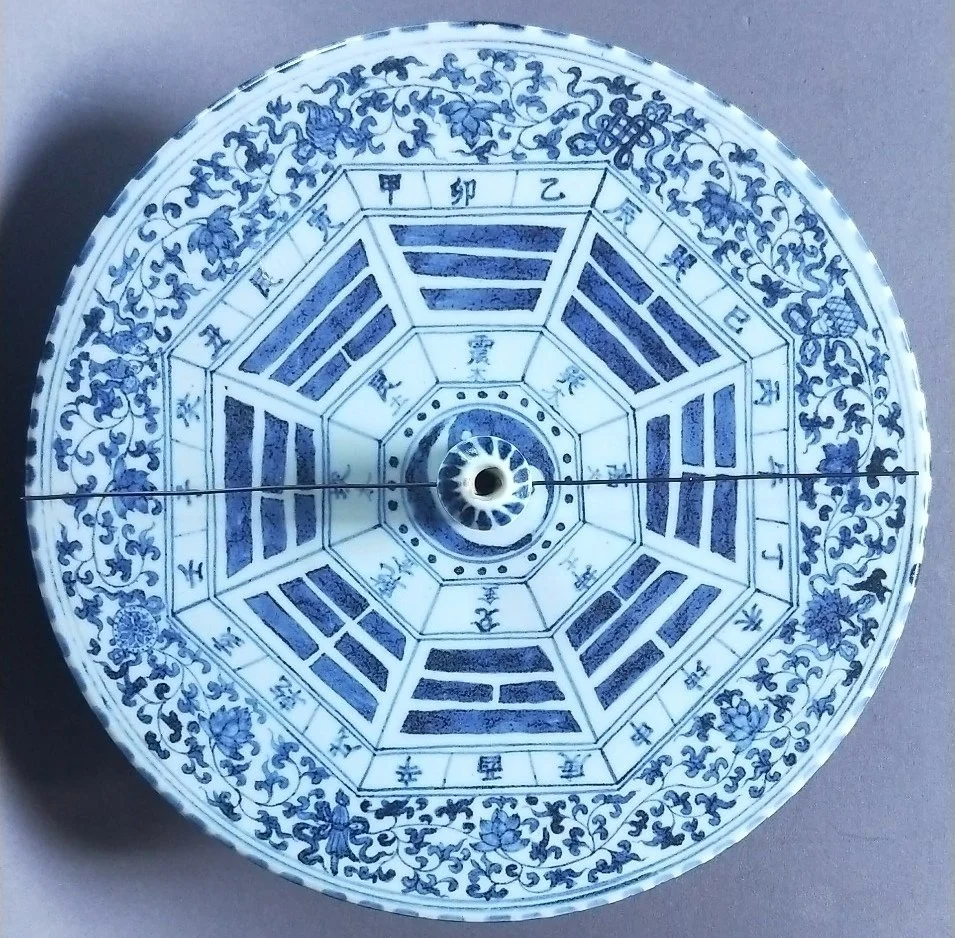
Figure 4. Compass with the mark "Wanli Xinmao Rucheng jiacang" — the taiji fish, taiji diagram, the 24 directions, and the Eight Treasures amid lotus and leaf scrollwork. Collection of Lim Keow Wah
• The supporting bowl: The outer wall is decorated all around with the Eight Miscellaneous Treasures and eight flying cranes amid 如意 ruyi-shaped cloud scrolls, the brushwork fluid and natural, the underglaze-blue color showing the typical characteristics of the Wanli period of the Ming dynasty.
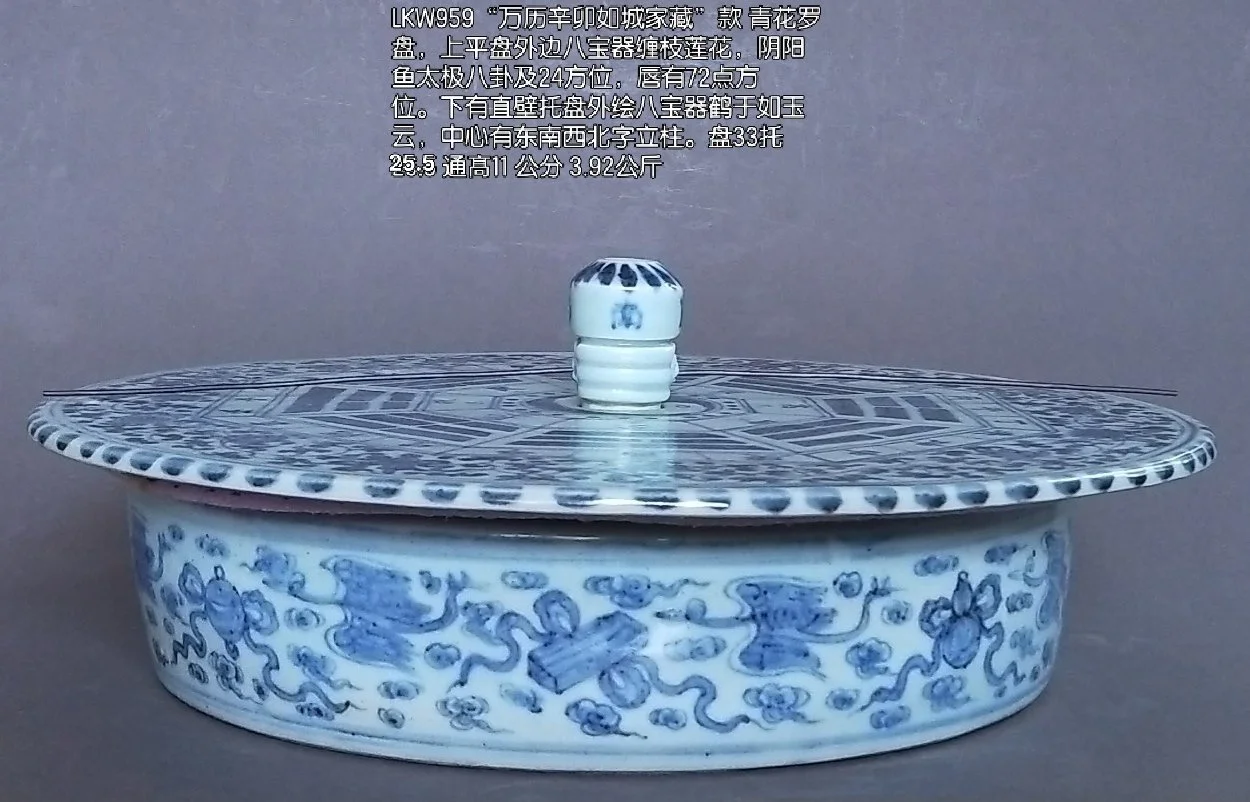
Figure 5. Compass with the mark "Wanli Xinmao Rucheng jiacang" — the Eight Miscellaneous Treasures and eight flying cranes amid ruyi-shaped clouds on the rim of the supporting bowl. Collection of Lim Keow Wah
The biscuit (paste)
• The base of the compass rose plate and the inner body of the bowl are unglazed, revealing a snow-white, hard, fine kaolin body, on which spiral trimming-knife marks remain. When the plate is tapped with a finger, it gives off a clear, high-frequency sound. This is consistent with the characteristics and dating of late Ming Jingdezhen porcelain.
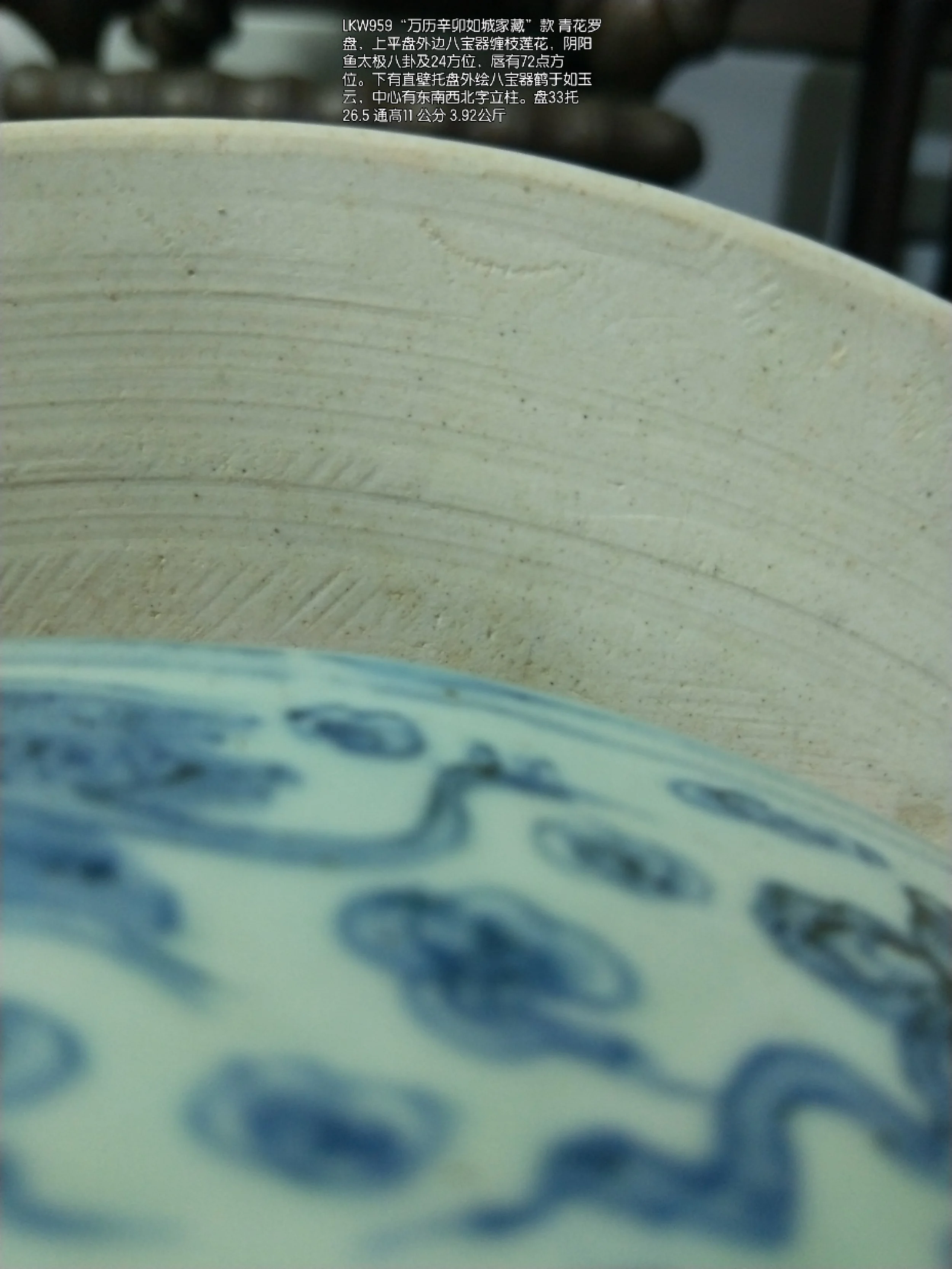
Figure 6. Compass with the mark "Wanli Xinmao Rucheng jiacang" — the rose base revealing a snow-white, fine kaolin body. Collection of Lim Keow Wah
• The outer base of the bowl is unglazed but coated with a layer of loose, coarse to touch protective glaze slip, showing an orange-red "flint red" (huoshihong) color.
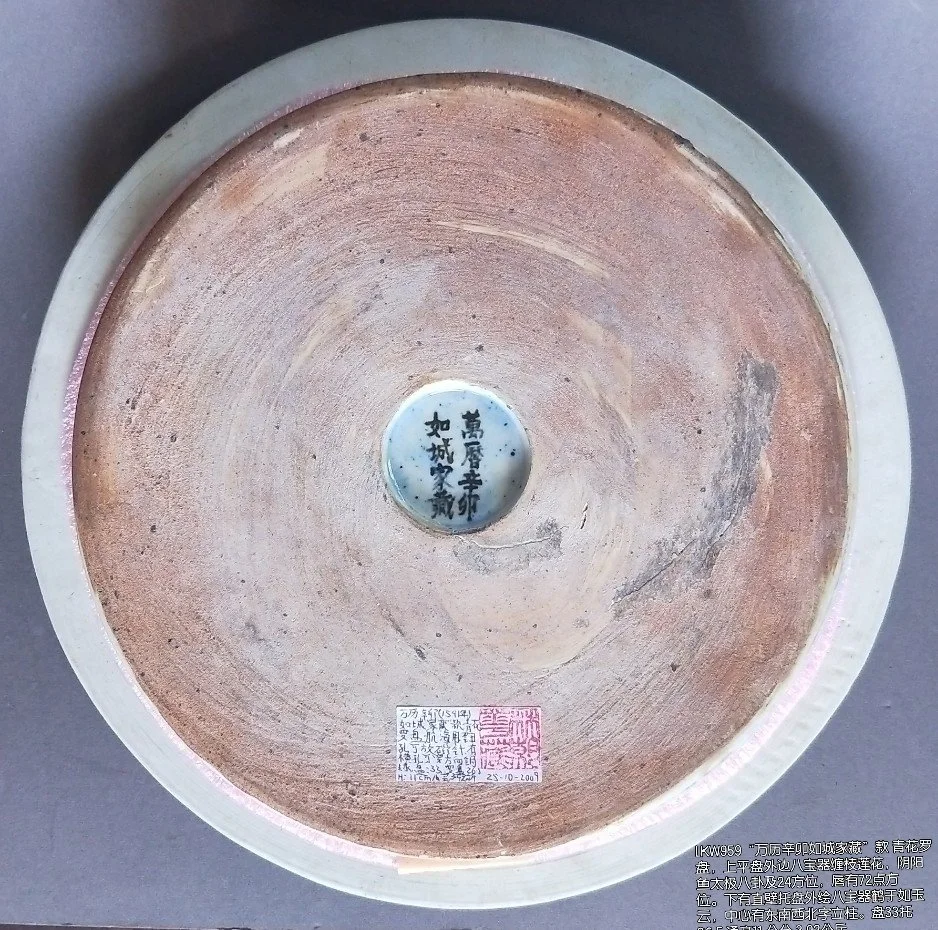
Figure 7. Compass with the mark “万历辛卯如城家藏” "Wanli Xinmao Rucheng jiacang" — the flat outer base of the bowl, unglazed and coated with protective slip, showing an orange-red "flint red" (huoshihong) color. Collection of Lim Keow Wah
The glass glaze and the blue pigment
• The transparent glass glaze is white with a grayish-bluish tinge and carries a clam-shell (iridescent) sheen. The lightly drawn areas are elegant and soft; the cobalt used for the painting is a grayish blue, the typical local blue of the late Ming. Where the cobalt is thick on the compass face, it shows sinking, iron-rust spots, and black blemishes, producing what people call "tin sheen" (锡光xiguang), which is in fact the crystalline sheen of the cobalt. Under a hundred-power magnifier it appears raised, with tortoise-shell cracking, flowing, and a reticulated crystalline structure — the typical Sumali (Su-ma-li) blue cobalt, but lacking the proper kingfisher-blue color. By the late Ming the imported Persian cobalt was almost exhausted, and the blue is probably a local cobalt mixed with a small amount of the surviving imported cobalt. These features, generally characteristic of Yuan or early Ming blue-and-white, differ from the iron-rust of modern Jingdezhen imitations (smooth, without variation or flowing) or from cobalt without crystallization.
• Under a hundred-power magnifier, the surface is covered with fine corrosion[KL1] pits that take several hundred years to form — a feature different from the modern faking methods of artificial aging by sandblasting or by chemical or acid erosion.
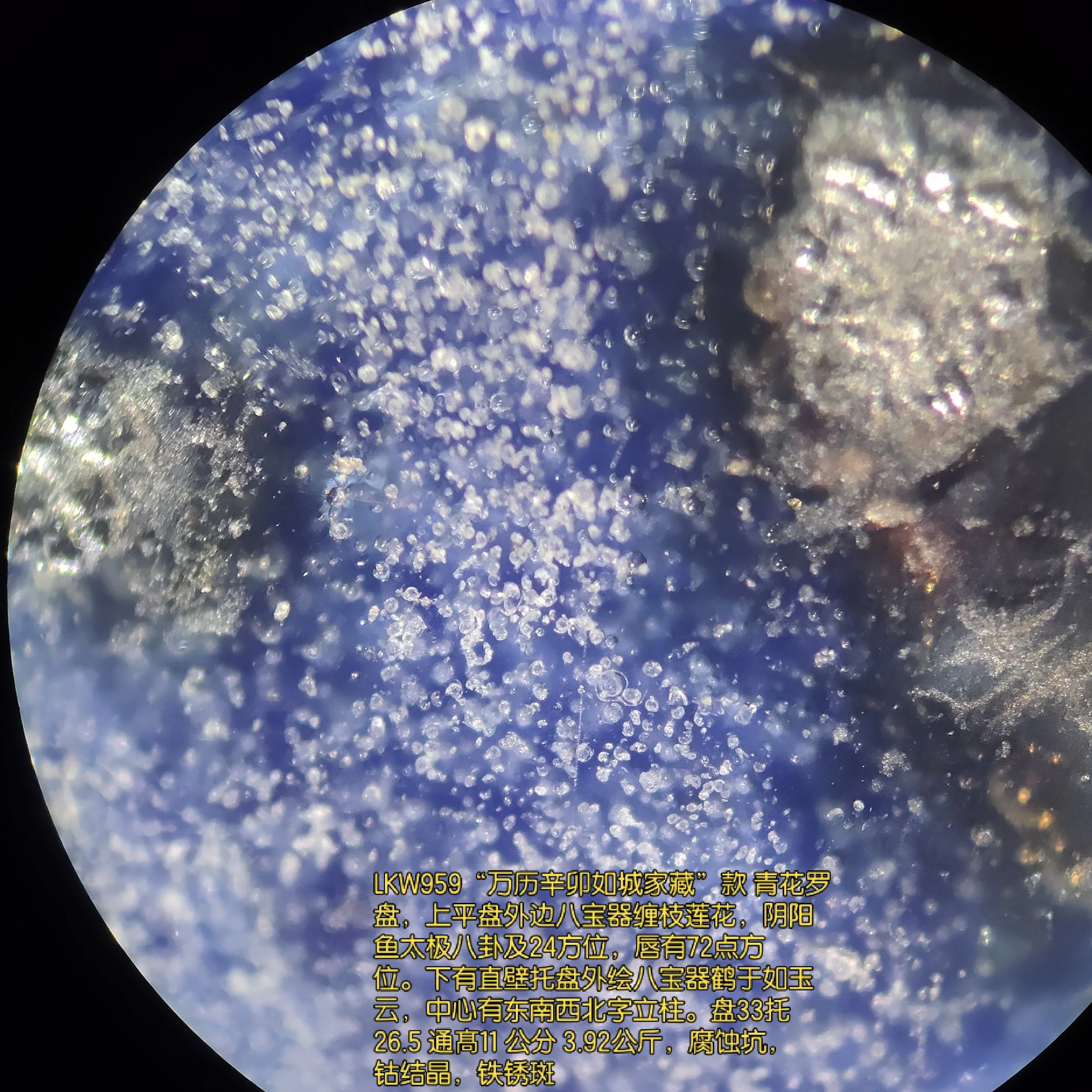
Figure 8. Compass with the mark "Wanli Xinmao Rucheng jiacang" — old corrosion pits on the glaze of the plate rose face, and the tortoise-shell, flowing, reticulated crystallization, possibly from the admixture of Sumali blue. Collection of Lim Keow Wah
• In the glaze appear varying shades black bubbles of depth within the glaze layer, which can only form when centuries of staining penetrate the surface glass glaze. In the glaze appear ancient white-mist small round crystals and snowflake-like crystalline flakes.
The mark "Wanli Xinmao Rucheng jiacang"
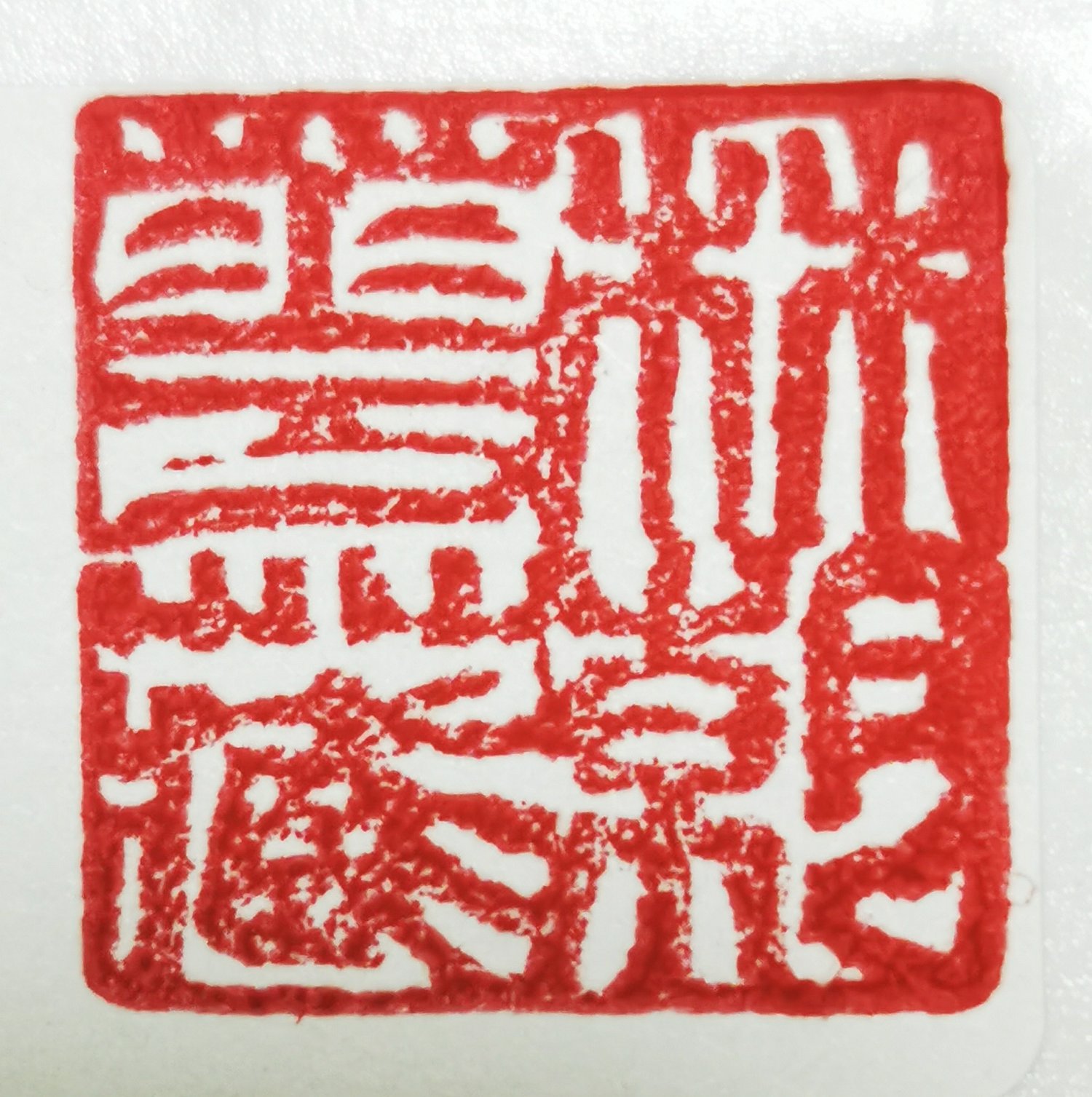
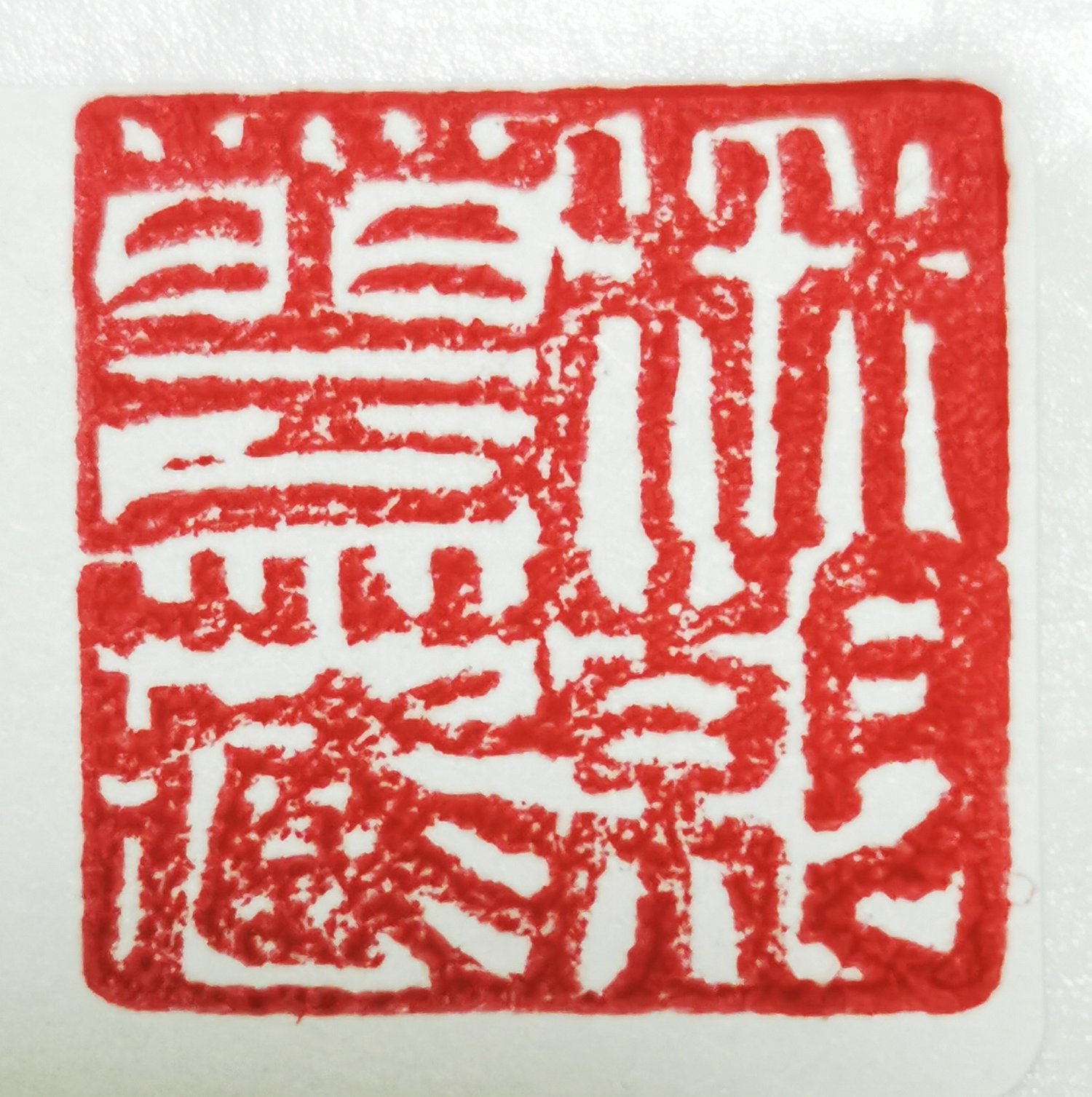
• The central mark: The flat base of the bowl is convenient for contact with the wooden surface and rotation. In the very center of the 玉璧bi-disc base is a small round recess so that the inscription would not be worn away; inside it is applied a light-blue transparent glaze, and in underglaze blue, in two vertical columns of regular script, is written the eight-character single-ring mark“万历辛卯/如城家藏” "Wanli Xinmao / Rucheng jiacang." The characters are rigorously structured and the brushwork is vigorous, in the same tradition as the inscription style of the known museum pieces bearing the "Wanli Xinmao Rucheng jiacang" mark.
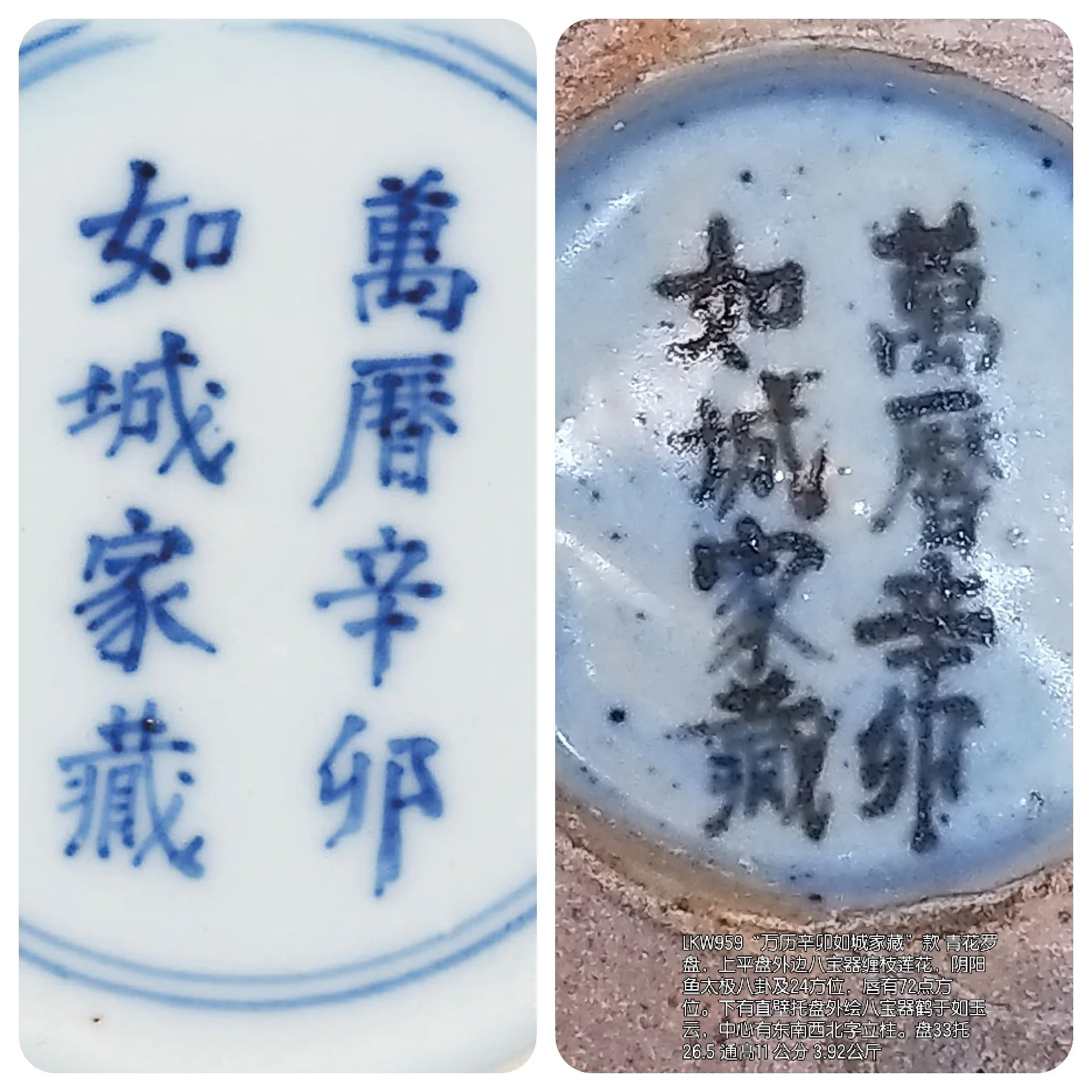
Figure 9. Left: celadon bowl with the mark "Wanli Xinmao Rucheng jiacang," collection of the British Museum. Right: the compass with the mark "Wanli Xinmao Rucheng jiacang," collection of Lim Keow Wah
This piece not only enriches the category of "Wanli Xinmao Rucheng jiacang" marked porcelains — beyond the monochrome-glazed bowls and dishes — with a special blue-and-white form, but is also an important piece of physical evidence for the study of the folk geomantic (堪舆kanyu) culture of the nineteenth year of the Wanli reign (1591) and of high-end custom-made porcelain from Jingdezhen.
Analysis of the size and the porcelain-making technique
Highly difficult technique: Before firing, the rotating compass rose plate had to be fitted between the supporting bowl and the pillar; after coming out of the kiln it is locked tight and cannot be taken apart, yet it must rotate smoothly around the central pillar. Rare large size: the diameter of the plate face reaches 33 cm, far exceeding the ordinary Qing-dynasty dry compasses of a little over 10cm in diameter. It also has a large flat rim protruding as wide as 3.3 cm out of the bowl wall, to be held between two fingers for smooth rotation. Apart from the second, fragmentary piece below, no other precedent has been seen; designing this mechanism and firing it was difficult, so the probability of its being imitated is very low.
• Difficulty of firing: This is a large, heavy piece among Ming blue-and-white scholar's-object and geomantic wares. The difficulty with imitating large flat-rimmed plate-type pieces is that they are extremely prone to sagging, warping, or cracking during high-temperature kiln firing. In order to support the broad 33 cm plate face and keep the compass graduations absolutely level, the craftsman deliberately thickened the body, bringing the total weight to an astonishing 3.92 kg.
• Harmonious structural proportion: The 25.5 cm straight-walled circular supporting base and the 33 cm broad rose plate rim form a stable "T"-shaped proportion, lowering the center of gravity. This both ensures stability when placed on a wooden table stand, and leaves ample space on the outer wall for painting the fine clouds and miscellaneous-treasure decoration.
The fragmentary blue-and-white compass plate in the collection of Mr. Xiao Daqi
肖大祺先生Mr. Xiao Daqi of Longnan Town, Longnan County, Ganzhou, Jiangxi Province, acquired this piece in Jiangxi in 2012, but it lacks the pillar and the bowl. Around the outer edge of the flat plate is a ring of fish-scale wave pattern; on the inner and outer faces are the yin-yang fish, the taiji and bagua, and the 24 directions. Outer diameter 30.3 cm. inner diameter 1.9cm, thick 0.67cm.
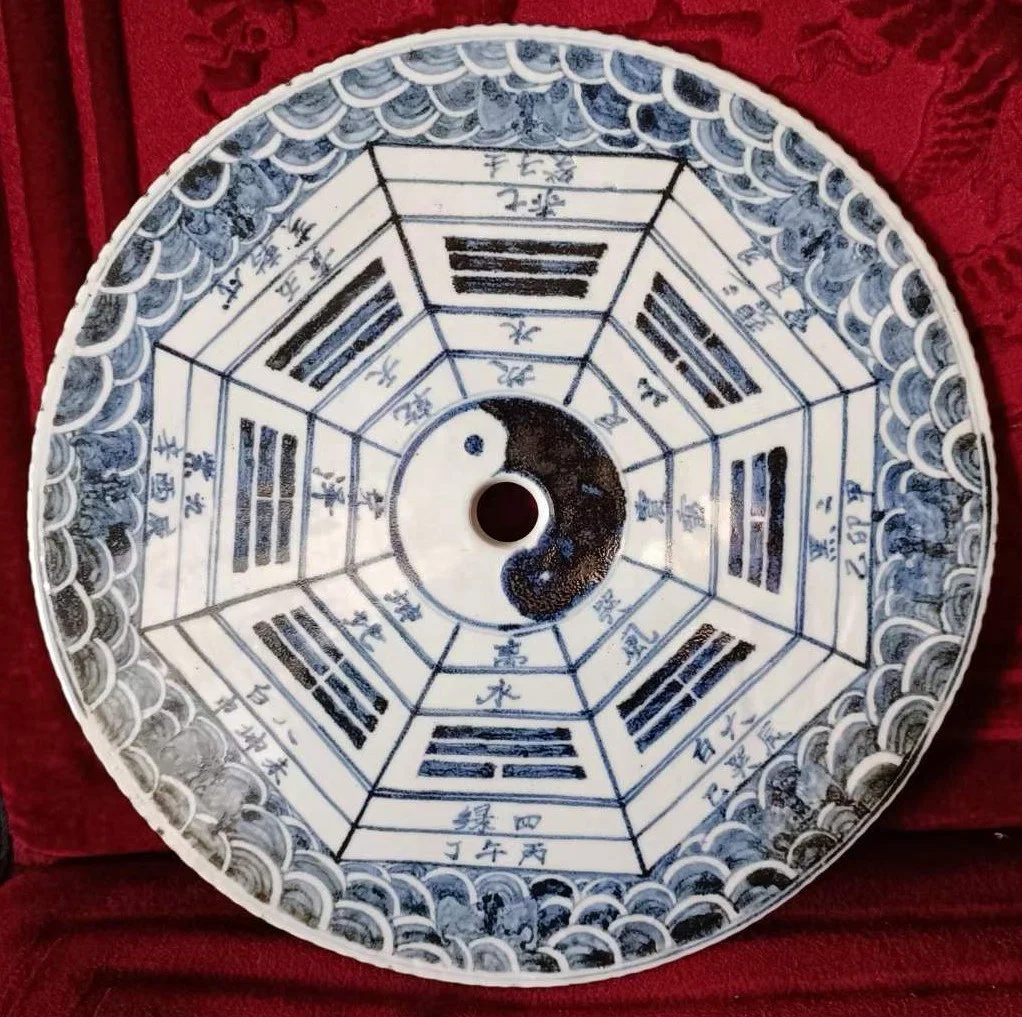
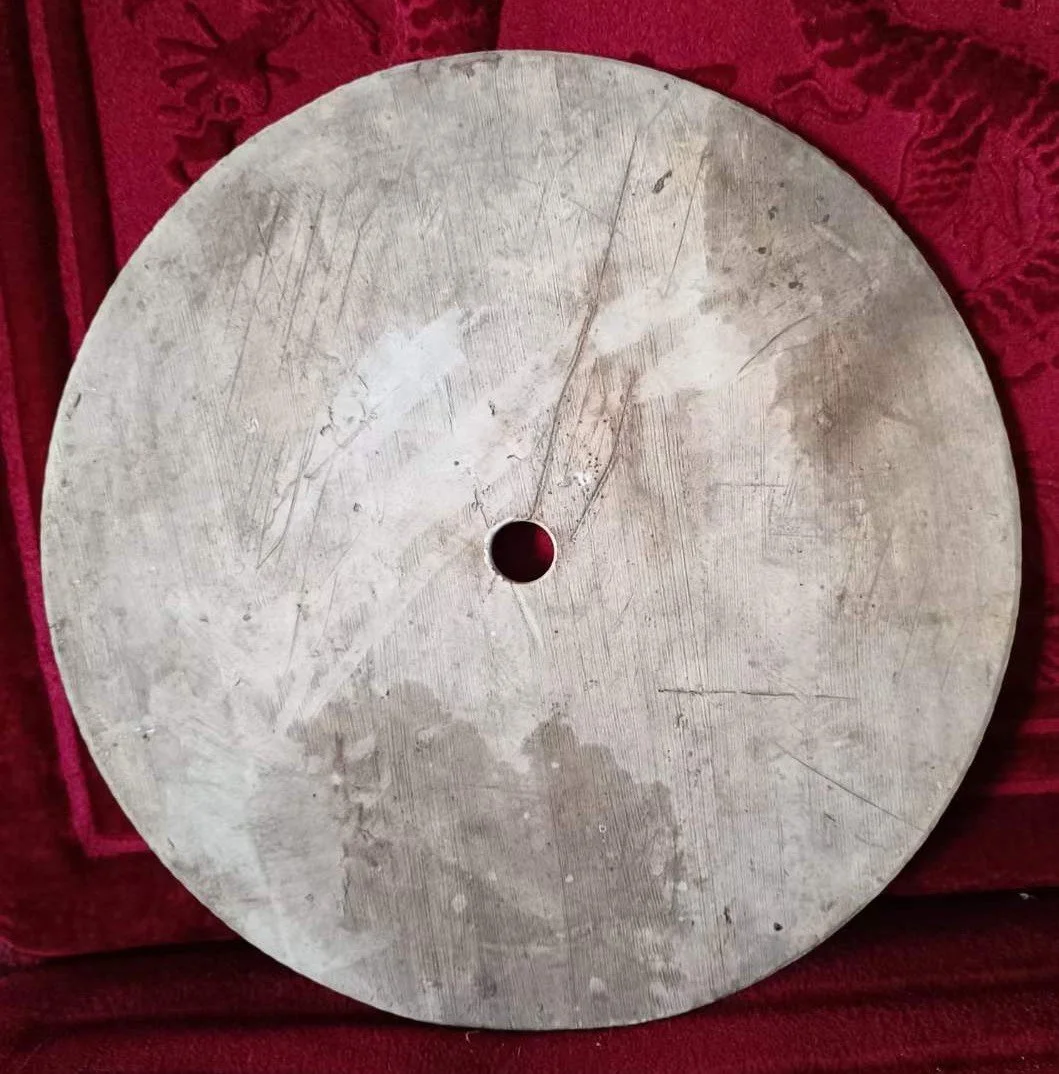
Figure 10. Fragmentary blue-and-white compass — the taiji fish and diagram, the 24 directions, and the fish-scale wave pattern on the rim. Outer diameter 30.3 cm, inner diameter 1.9 cm thick 0.67cm. Collection of Xiao Daqi, Longnan Town, Longnan County, Ganzhou, Jiangxi Province.
Differences between the two compasses
The decoration of the piece in Xiao Daqi's collection is broadly similar to the author, but the rim is painted with a fish-scale wave pattern, the rendering of the yin-yang fish differs, and the outer and inner diameters are each smaller by 2.7 cm and 0.7cm respectively, however thickness is. 0.07cm more , The glaze, body, and pigments are all in the same tradition and come from the same kiln, and the period and use are the same.
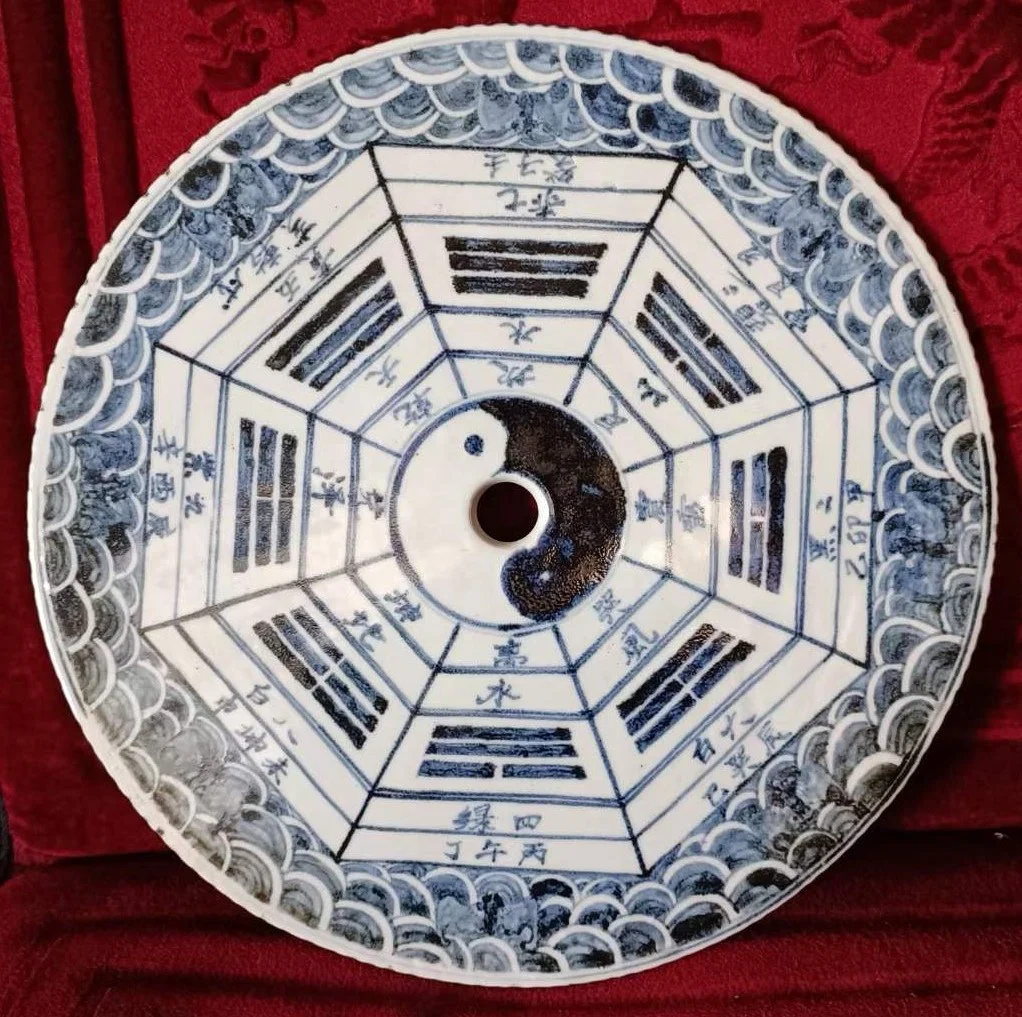
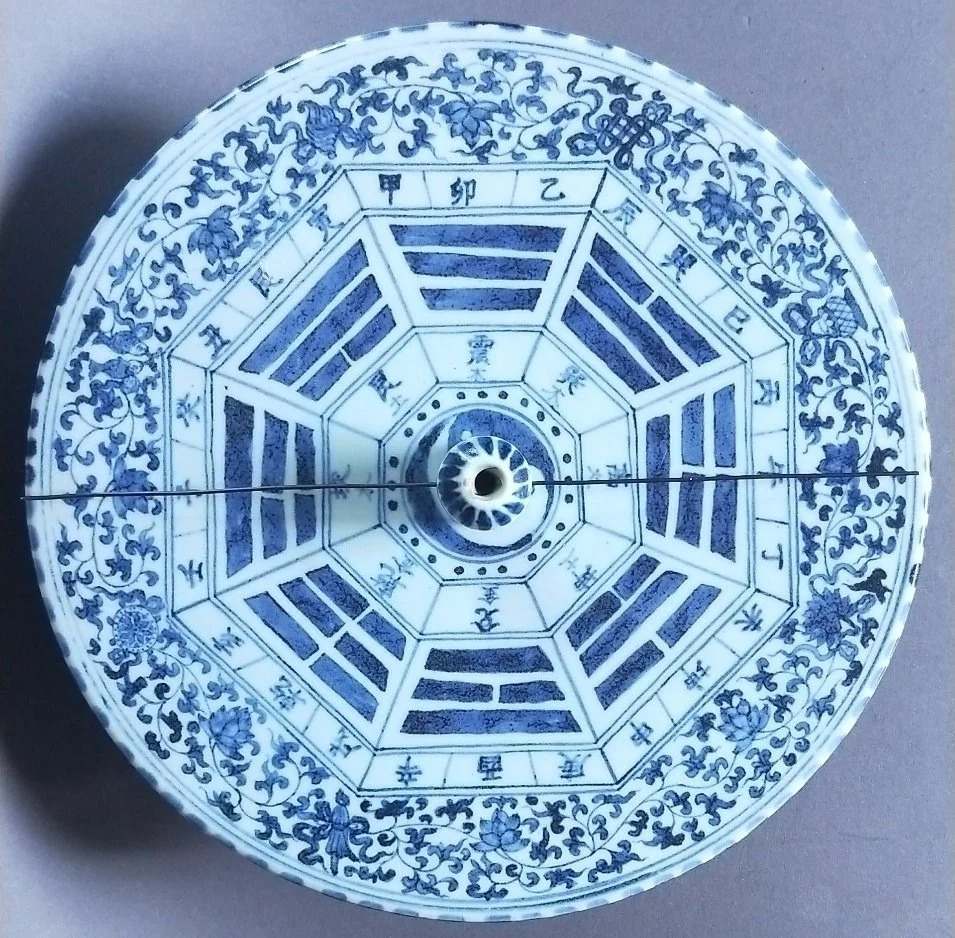
Figure 11. Left: fragmentary blue-and-white compass rose, collection of Xiao Daqi. Right: the compass rose and pillar with the mark "Wanli Xinmao Rucheng jiacang," collection of Lim Keow Wah
A study of sea compasses across the Chinese dynasties
The ancient Chinese navigational compass evolved from the magnetic knowledge of the pre-Qin period and the geomantic 堪舆栻盘kanyu shi-board (shipan) of the Han and Tang, to the "wet compass" of the Song and Yuan, which established the 24-direction system, and then to the Ming and Qing transition to the "dry compass," combined with the Hai Dao Zhen Jing (Manual of Sea-Route Needles). It combined artificial magnetization technology with the traditional system of heavenly stems, earthly branches, and bagua directions, propelling China to be the first, in the Song dynasty, to enter the era of all-weather "quantitative navigation." The following is a study of some surviving sea compasses.
The Song "south-pointing turtle" (指南zhinan gui)
This usually refers to the "south-pointing turtle" invented in the Song dynasty (also regarded by historians of science and technology as the prototype of the modern "dry compass"), which began to be used in fengshui compasses, and to its combined designation in the evolutionary history of the navigational compass.
Core structure: A piece of natural lodestone is embedded in the belly of a wooden turtle; beneath the belly of the wooden turtle a small smooth recess is carved out, and it is placed on a sharp, smooth bamboo pin (the pivot) standing upright on a wooden board.
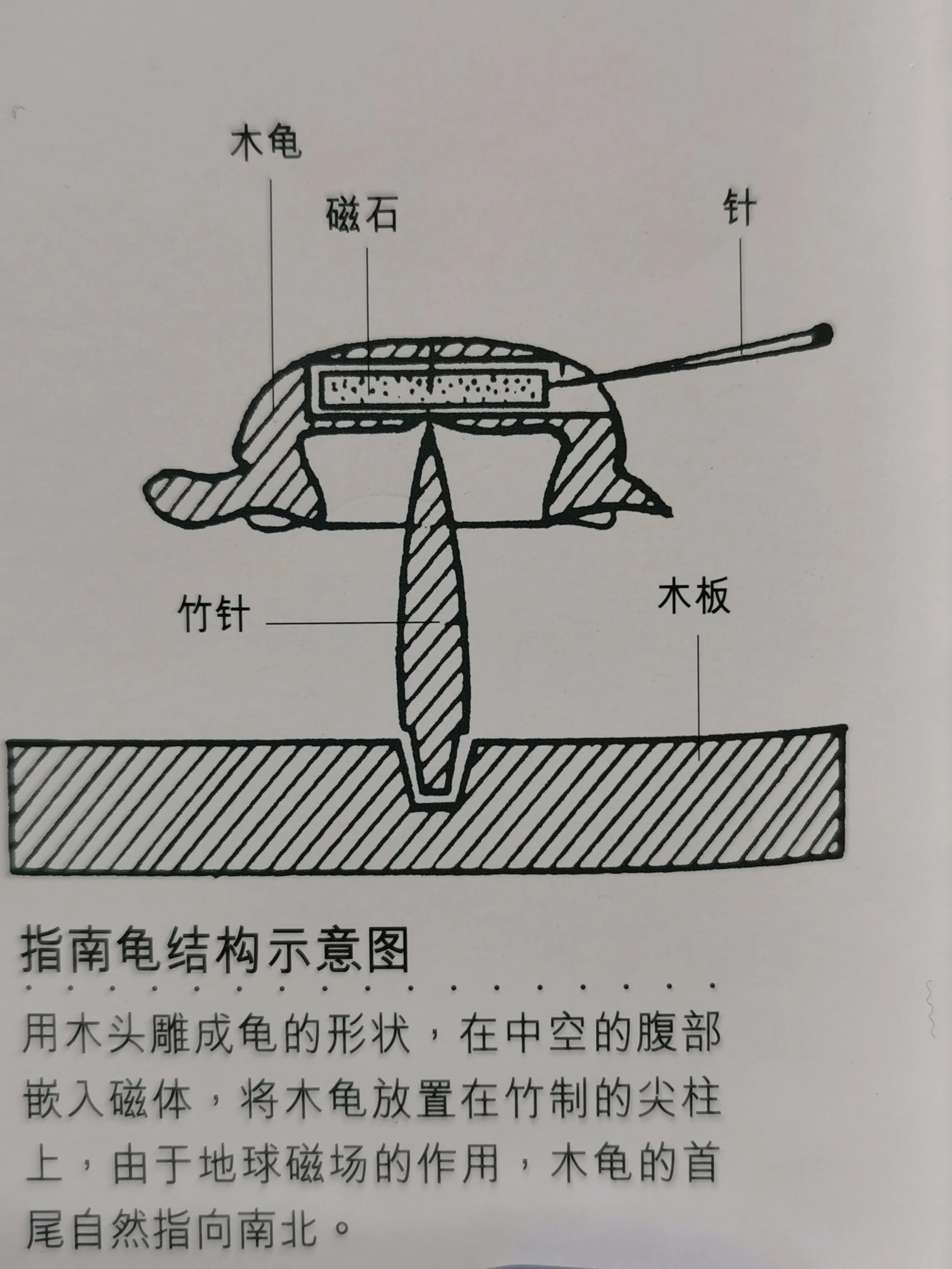
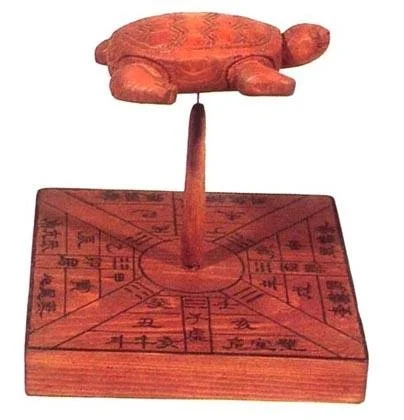
Figure 12. Schematic diagram of the Song "south-pointing turtle" dry compass and a modern replica.
The Yuan blue-and-white wet-compass bowl
A fragment of a Yuan blue-and-white wet(water)-compass bowl was unearthed at the Temasek (Fort Canning Hill) site in Singapore. In the center of the bowl is the character "筭" (suan, homophonous with and identical in meaning to "算" calculate), and below the character "筭" only the upper part of the character "人" (ren) remains of the following damaged character — whether it is the character "命" (ming) is uncertain; if so, the two characters would read "算命" (suanming, fortune-telling). The view of the archaeological authority is that it is a navigational wet compass, but the author's personal view is that if the two characters are indeed "算命," then whether it is related to a fengshui compass is open to question. The center of the bowl's base is quite thick, so the diameter of the bowl appears to be not small. The glaze is egg-white and shows fine crackle, possibly because a protective body slip was generally applied beneath the glaze. The cobalt pigment has a grayish-black tone, possibly due to the glaze material applied, its thinness, or the low temperature at the position where the vessel was placed in the kiln.
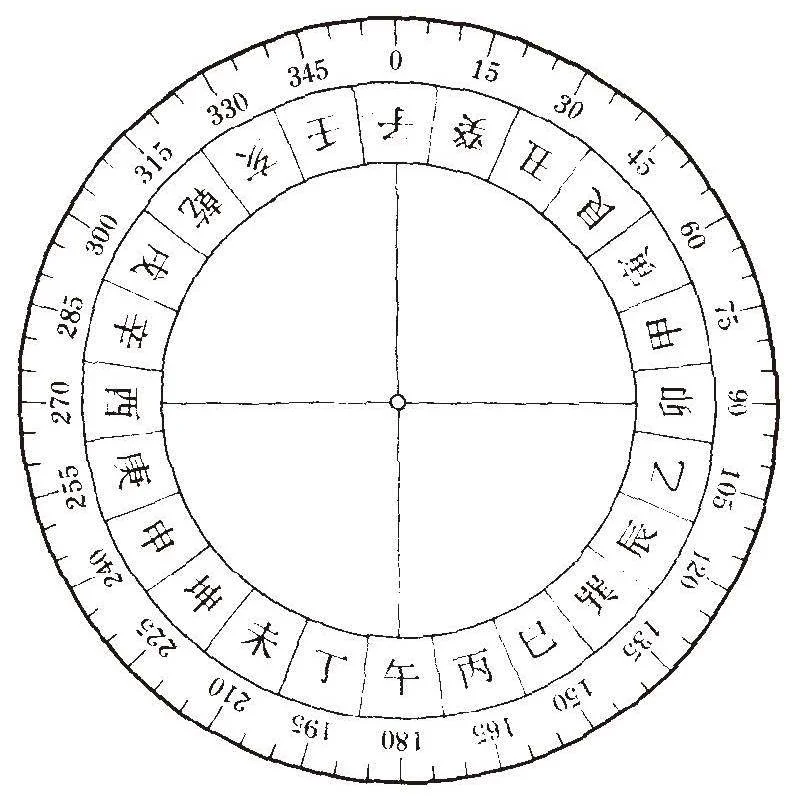
Figure 13. Overlapping comparison of the ancient Chinese 24-direction system and the modern 360-degree compass rose.
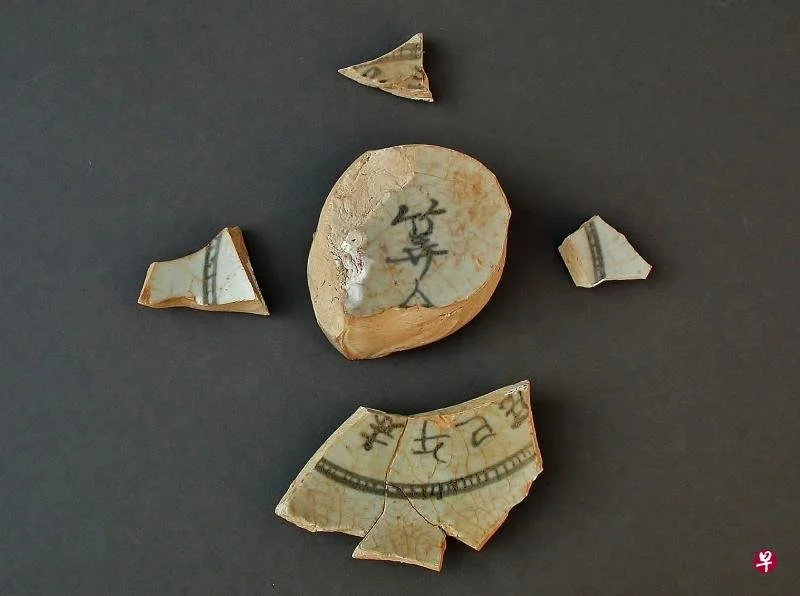
Figure 14. Fragment of a Yuan blue-and-white water-compass bowl with the character "筭" (suan) calculate, unearthed at Fort Canning Hill. Collection of the Asian Civilisations Museum
The wooden compass of Zheng He's fleet in the Ming dynasty
Gong Zhen (1371–1457), author of 西洋番国志Xiyang Fanguo Zhi (Record of the Foreign Countries of the Western Ocean), wrote this book after
accompanying Zheng He on his seventh voyage to the Western Ocean. In the book he records: "皆斫木为盘,书干支之字,浮针于水,指向行舟"
• 皆斫木为盘 (jie zhuo mu wei pan): All hewed and cut wood to make the body of the compass plate ("斫" means to chop or pare).
• 书干支之字 (shu ganzhi zhi zi): On the wooden plate were written or carved the heavenly stems and earthly branches (as well as the bagua and other traditional directional markers) to serve as graduations and directional guides.
• 浮针于水 (fu zhen yu shui): The magnetized steel needle was floated on the water, so that it could turn freely and point steadily north–south.
• 指向行舟 (zhi xiang xing zhou): Relying on the magnetic needle's pointing, combined with the graduations on the plate face, to determine the course and guide the vessel.
The Ming porcelain water(wet) compass
In the late Ming dynasty, large numbers of 五彩wucai (polychrome) porcelain compasses were produced, mostly painted with sea-related motifs. These porcelain plates were fired at the 平和Pinghe南胜Nansheng kiln sites in Zhangzhou, in the mid-to-late Ming. The plates are often painted with compass rose directions, sea beasts, Westerners, and foreign sailing ships. In the center of this plate is written the mark “ 天下一” "Tianxia Yi" (First under Heaven), with the 24-direction characters of the compass. The lip is marked with graduated divisions. It is conjectured that a small magnetic needle was sealed inside a reed stalk, with both ends sealed, and the reed stalk with the needle was floated on the water surface of the small cup in the center of the plate.
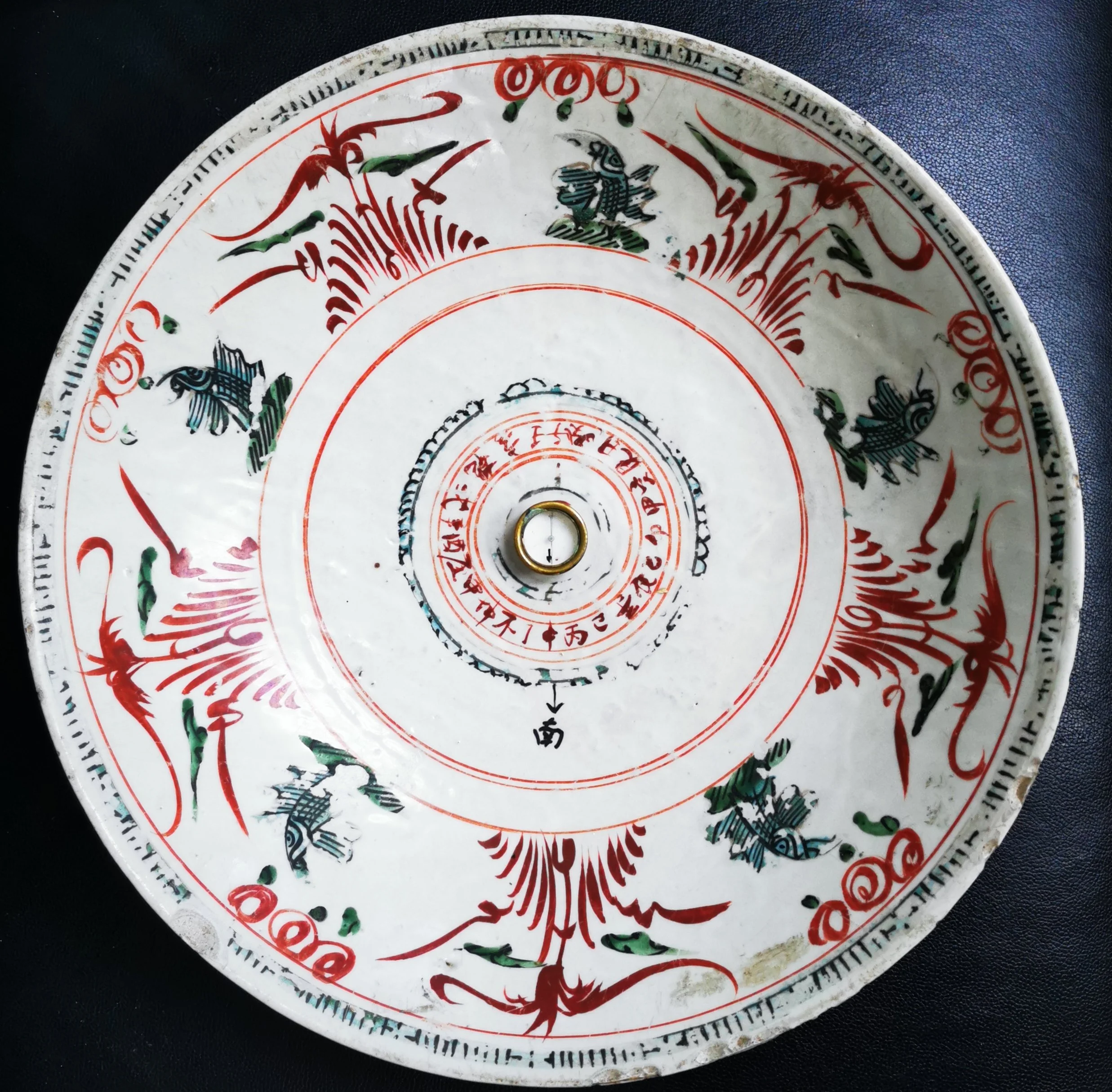
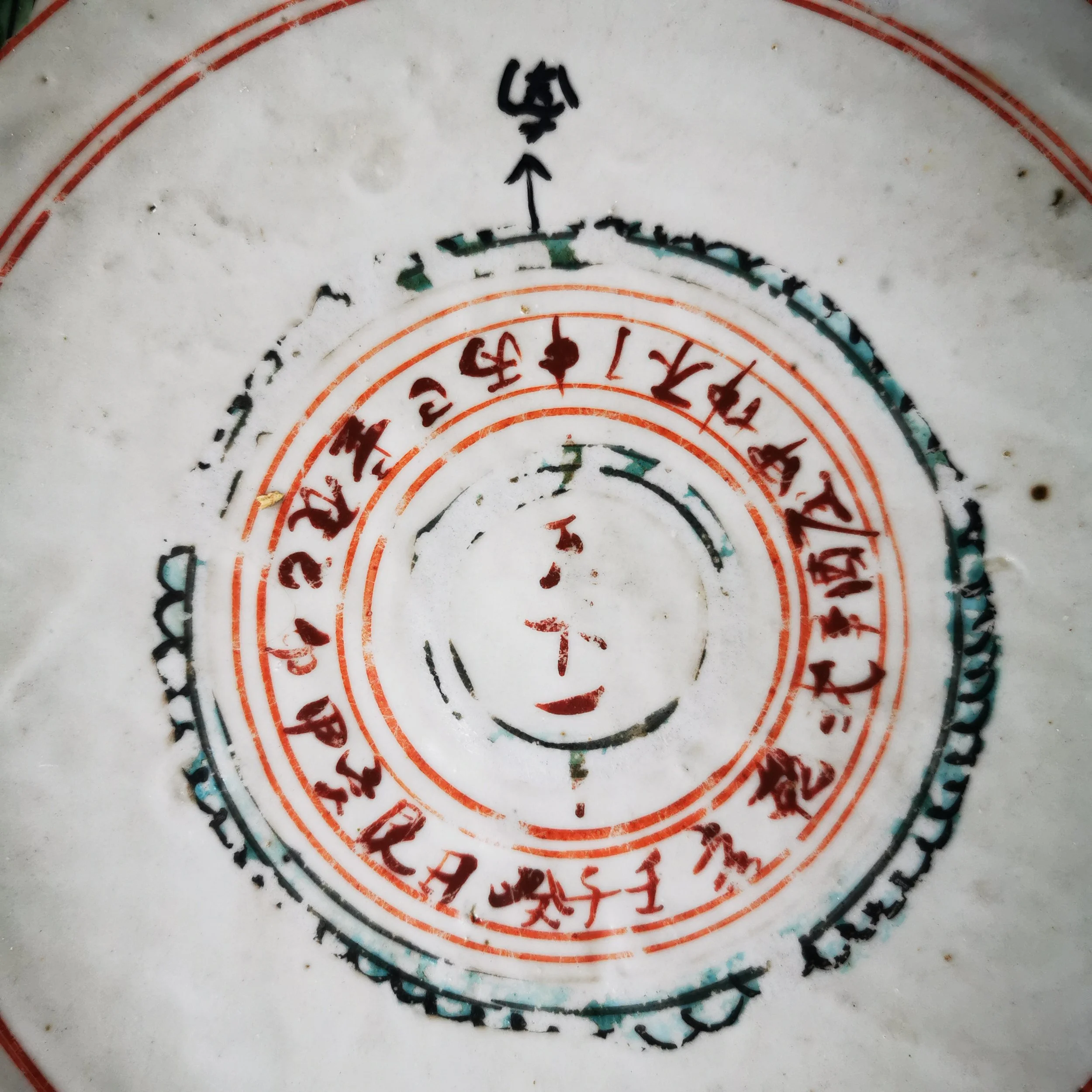
Figure 15. Red-and-green wucai porcelain wet compass with five fish and the mark “天下一”"Tianxia Yi" (First under Heaven), from the Pinghe /Nansheng kiln, Zhangzhou, mid-to-late Ming dynasty; diameter about 40 cm. Collection of the late Dr. Tan Ta Sen.
The Qing wooden-body dry compass
This Qing-dynasty dry compass has a wooden body made into a cylinder, fitted with an openable round wooden lid that protects a glass-covered window. The arrow-shaped magnetic needle is balanced and supported at its midpoint by a small round bearing on a central vertical pointed pivot, allowing it to rotate precisely to every direction. Around the top face are written the eight heavenly stems and four trigrams, marking out the twenty-four basic directional positions of the compass.
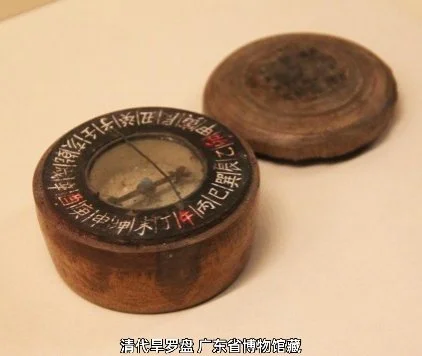
Figure 16. Qing-dynasty wooden-body dry compass. Collection of the Guangdong Museum.
The Republican-period fengshui wooden compass
A Republican-period fengshui square lacquer wooden compass with the base mark “林君达造”"Lin Junda zao" (made by Lin Junda), measuring 16.5 × 16.5 × 2.2 cm and weighing 247 g. The face of the round wooden compass rose is lacquered black, with the directions written in red and the degrees marked in ruled divisions. A dry-compass copper case, 2.7 cm in diameter, with a glass window, is compactly set into the center of the round plate. The round wooden plate is in turn set into a red-faced square wooden tray, so that it can be turned freely through 360 degrees. On the square wooden tray are the positioning threads of the plate (the 天心十道"Tianxin shidao," the cross-lines through the center of heaven). This century-old magnetic compass needle, supported on a vertical pointed pivot, is still very sensitive and points accurately to the north.
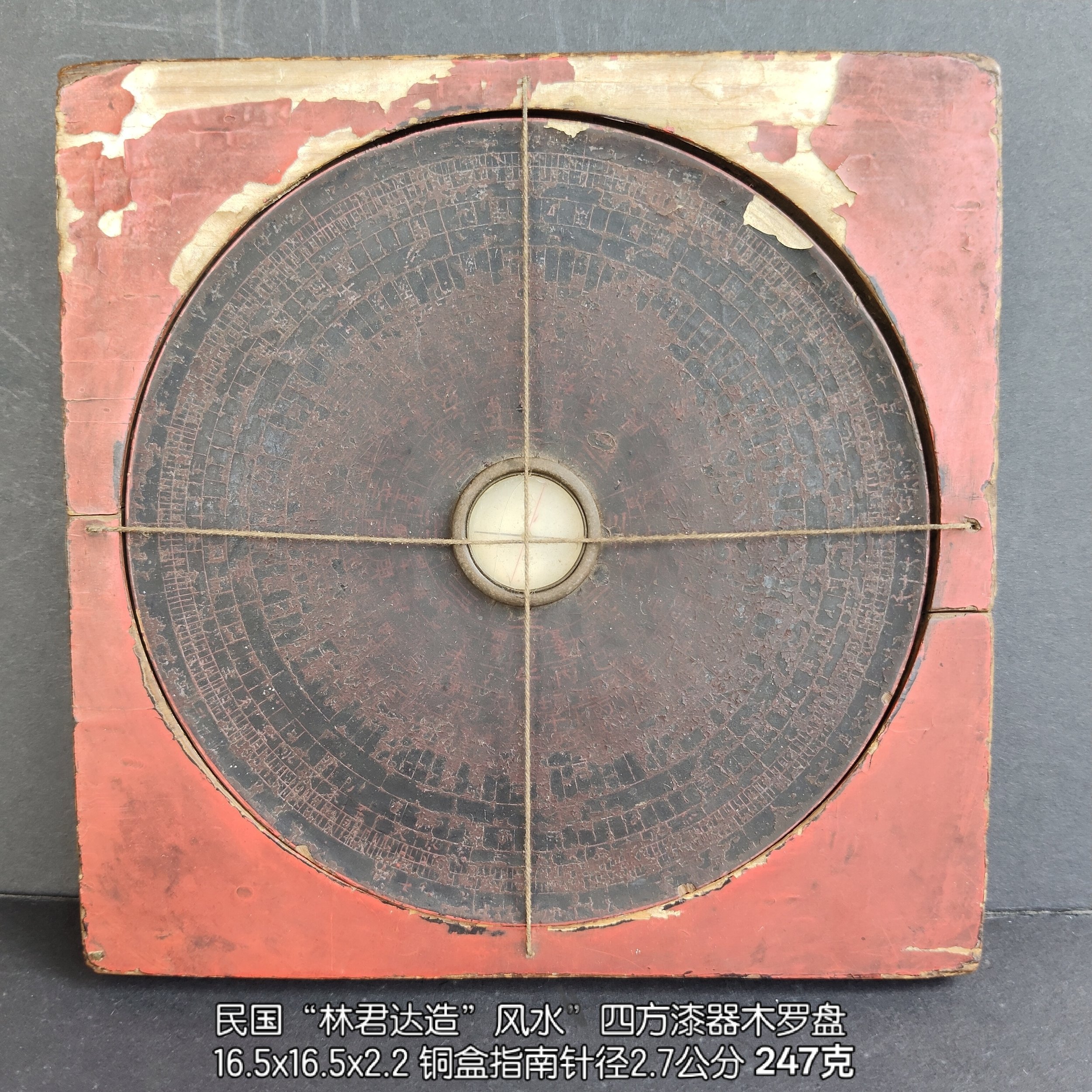
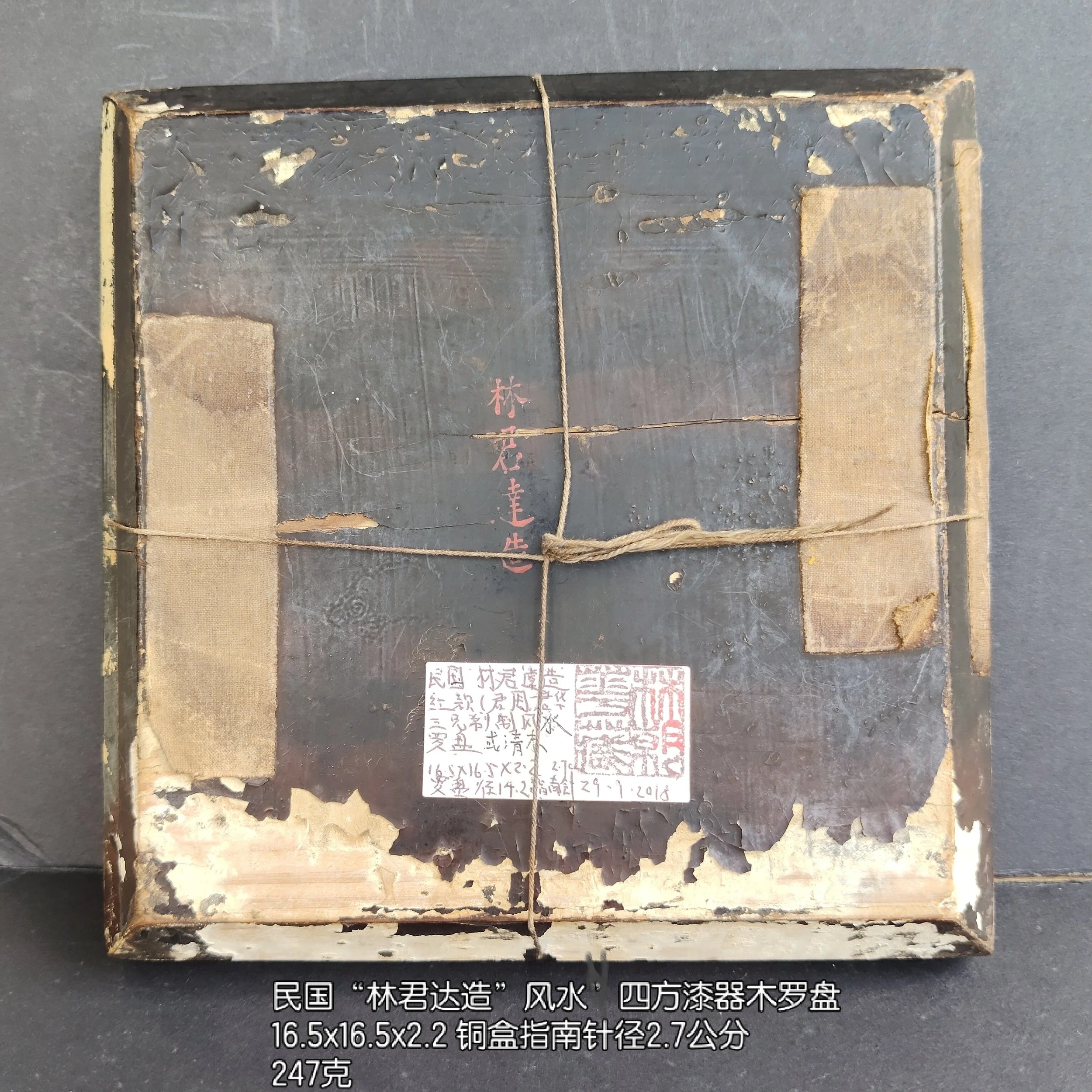
Figure 17. Republican-period fengshui square lacquer wooden compass with the mark "Lin Junda zao" (made by Lin Junda), 16.5 × 16.5 × 2.2 cm, 247g. Collection of Lim Keow Wah
The use of the blue-and-white compass with the mark "Wanli Xinmao Rucheng jiacang"
From the various compasses of the Song, Yuan, Ming, Qing, and Republican periods introduced above, we can only roughly know their different, specific uses. The following is an analysis of the use of the blue-and-white compass with the "Rucheng jiacang" mark:
• High scientific and technological content: Apart from the fragmentary blue-and-white compass in Xiao Daqi's collection, this is the only blue-and-white device discovered to date that allows the round compass plate to rotate independently around the round supporting tray and the compass-needle pillar; no such design has been seen in ancient China or even in the ancient West. If made of non-magnetic copper or wood, it would be very difficult or expensive. The difficulty lies in the fact that the three parts — the round compass plate, the supporting tray, and the pillar — could only be assembled before firing and then put into the kiln; after coming out of the kiln the plate can still rotate but cannot be disassembled. It seems more like something designed for navigational precision.
• Complex porcelain technique: It is somewhat similar to the Qianlong imperial openwork multi-layered revolving-vase (转心瓶zhuanxin ping). But this piece is not a decorative object — it is a practical instrument.
• The fragmentary blue-and-white compass in Xiao Daqi's collection has a ring of sea-water fish-scale pattern painted around the flat plate, which seems more connected with marine navigation.
• Overall weight of 3.92 kg: Compared with the Republican "Lin Junda zao" fengshui square lacquer wooden compass, which weighs only 247 g, it is much heavier, so that one cannot hold it in the hands for long or keep it steady. It is therefore not an object for portable fengshui use.
• Flat form with a low center of gravity: It seems more like something designed to prevent the compass from tipping over when a ship rolls in heavy seas.
Conclusion on its use: It is a practical instrument — a compass designed and made specifically for marine navigation.
The operating procedure of the blue-and-white compass with the mark "Wanli Xinmao Rucheng jiacang"
• It had to be installed on a tall round wooden stand on the central axis of the ship's wheelhouse, at a height from which the view ahead of the ship and to the left and right could be seen through the window; it could also be set up or moved to a position near the port or starboard side. The installation position was best placed close to the helmsman, so that steering orders could be passed on directly.
• The base of the tray was fitted into a specially made round wooden stand; as shown in Figure 18., the later-added round wooden stand has a raised rim and a shallow recess with an inner diameter of 25.7 cm. There had to be a small clearance between the tray wall and the wooden base (the space between the wall of the tray and the rim of the wooden stand is 0.1 cm), so that the tray could rotate smoothly but not so loosely as to cause the compass to deviate from the center of the wooden stand or slip out.
• It is even possible that a two-axis gimbal frames was fitted on the wooden stand to keep it level amid the waves.
• A hard, straight copper orientation wire was inserted through the "east" and "west" holes beneath the compass pillar.
• On the central mortise hole of the compass pillar was inserted a compass with a tenon at its base; at the center of the upper end of the compass- plate could be set a vertical, hard copper sighting wire for fixing the direction.
The physical design and operation of this porcelain compass are somewhat close to those of the Republican "Lin Junda zao" fengshui square lacquer wooden compass in Figure 17.
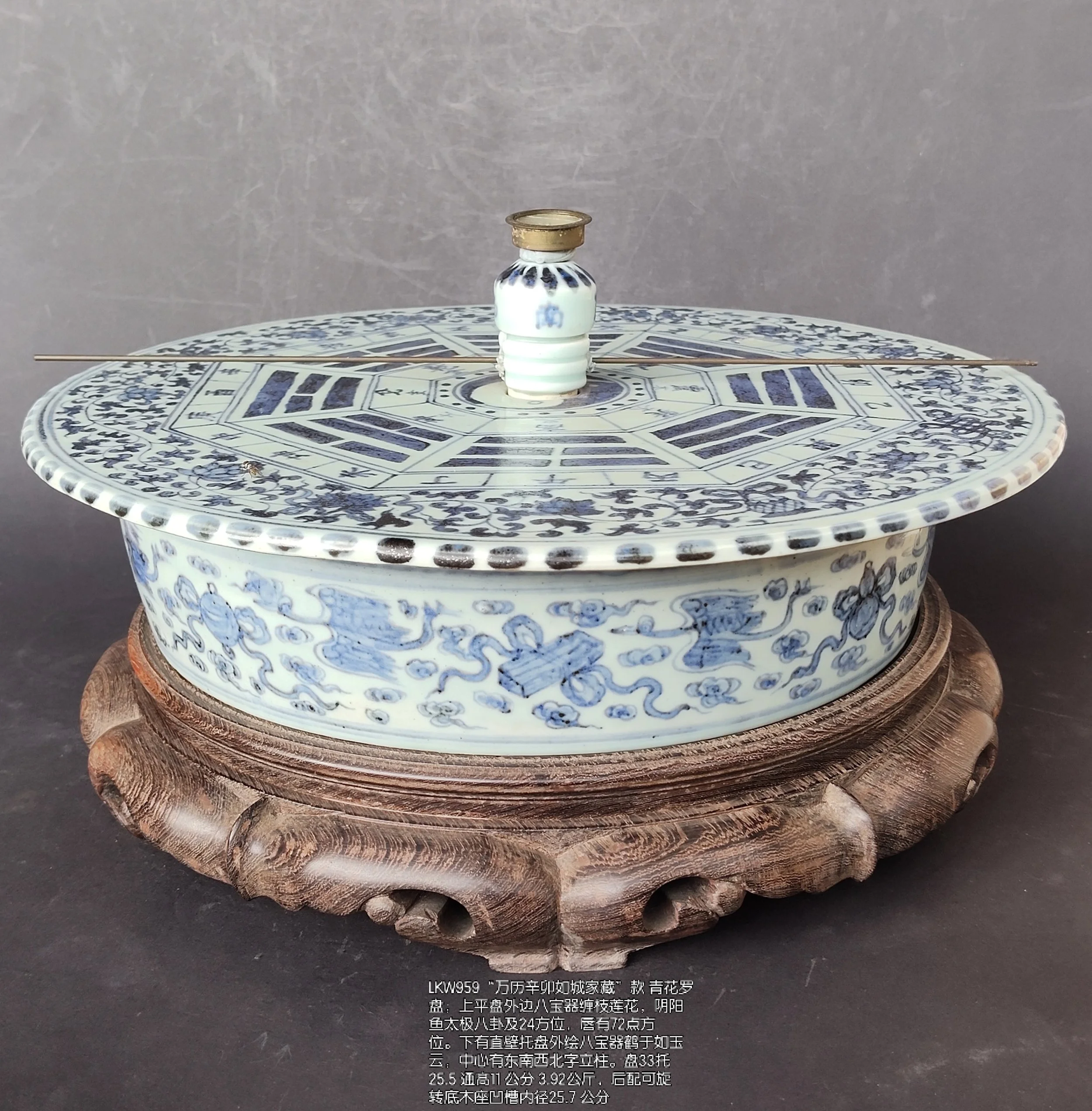
Figure 18. Compass with the mark "Wanli Xinmao Rucheng jiacang," with a later-added wooden stand on the base, having a raised rim and a round recess 25.7 cm in diameter, on which it can rotate. Collection of Lim Keow Wah
• Adjusting the compass
Steady the ship's heading (do not change course).
With the left and right palms holding the wall of the compass tray, slowly rotate it on the wooden stand until the compass needle aligns with the character "南" (south) on the porcelain pillar.
With two hands each with two fingers gripping the rim of the compass rose plate above and below, slowly rotate it until the horizontal copper wire in the "east" direction on the compass pillar aligns with the character "卯" (mao, the east direction) on the rose plate. At this point the compass plate, the pillar, and the compass needle are all aligned. The premise is that during and after the adjustment the heading must not be changed.
• Finding the course: After step 3, the degree or direction read on the round compass rose at the longitudinal axis line ahead of the ship's bow is the ship's magnetic course at sea. The magnetic declination error in Singapore is +0.24 degrees. The magnetic direction must be corrected by +0.24 degrees to obtain the correct ship's heading.
• Taking the bearing of a distant object: After step 3, stand behind the line joining the compass and a distant object such as a mountain peak, island, sun, moon, or star; with one eye, sight along the compass-needle center / vertical copper wire and the selected distant object in a single line, and read the bearing from the front edge of the round compass rose.
• After the magnetic needle has been adjusted, each time the ship's heading changes, the "adjusting the compass needle" procedure must be repeated after the heading has steadied.
Who was the person behind the private mark "Rucheng jiacang"?
The patron of the private mark "Rucheng jiacang" is attested by several other porcelains bearing the same mark that have appeared in museums in Britain, Sweden, and Hong Kong, and at Christie's Hong Kong spring auctions. The question to explore is whether "Rucheng" is the name of the collector — but no such person can be found anywhere. Or is "Rucheng," as stated online, a reference to the place name 如皋Rugao? This collector must have been a person of great wealth, with the means to commission large numbers of porcelains bearing a private mark, and a person of power or official rank. Because the compass is a navigational instrument, it is conjectured that he may have been connected with a great merchant engaged in ocean-going trade, or with a senior naval commander.
Conclusion
The author has collected this compass for 17 years, and had long since gathered a good deal of material and wished to write an article, but was delayed by other matters and research. This unique 435-year-old late Ming ancient Chinese navigational instrument comes two hundred years after Zheng He's voyages to the Western Ocean. Is it related to Zheng He's navigational compass? Or, as Gong Zhen said, the compasses used at that time were all wooden wet compasses, and this piece has no connection with them — but there are exceptions to everything. Drawing on my knowledge of ocean-going navigation and of Yuan, Ming, and Qing porcelain collecting, I have written this article in the hope of sharing and exchanging views with everyone, and in the hope that scholars will carry out further research and discussion, so that the great invention of the compass in ancient Chinese science and technology may become clearer.
By Captain Lim Keow Wah, written on 27 November 2026.
For many years in the service of ExxonMobil, having served as navigation consultant for super tankers in the Strait of Malacca, harbor master, and chartering consultant. Now retired.
President of the Singapore Penjing and Stone Appreciation Society.
Deputy Secretary of the International Zheng He Society (Singapore).
Deputy Director of the Zisha (purple-clay) Pot and Container Professional Committee (China). Has organized large-scale antique auctions.
Email: limkeowwah@gmail.com
Antique collection and research website: limkw.com